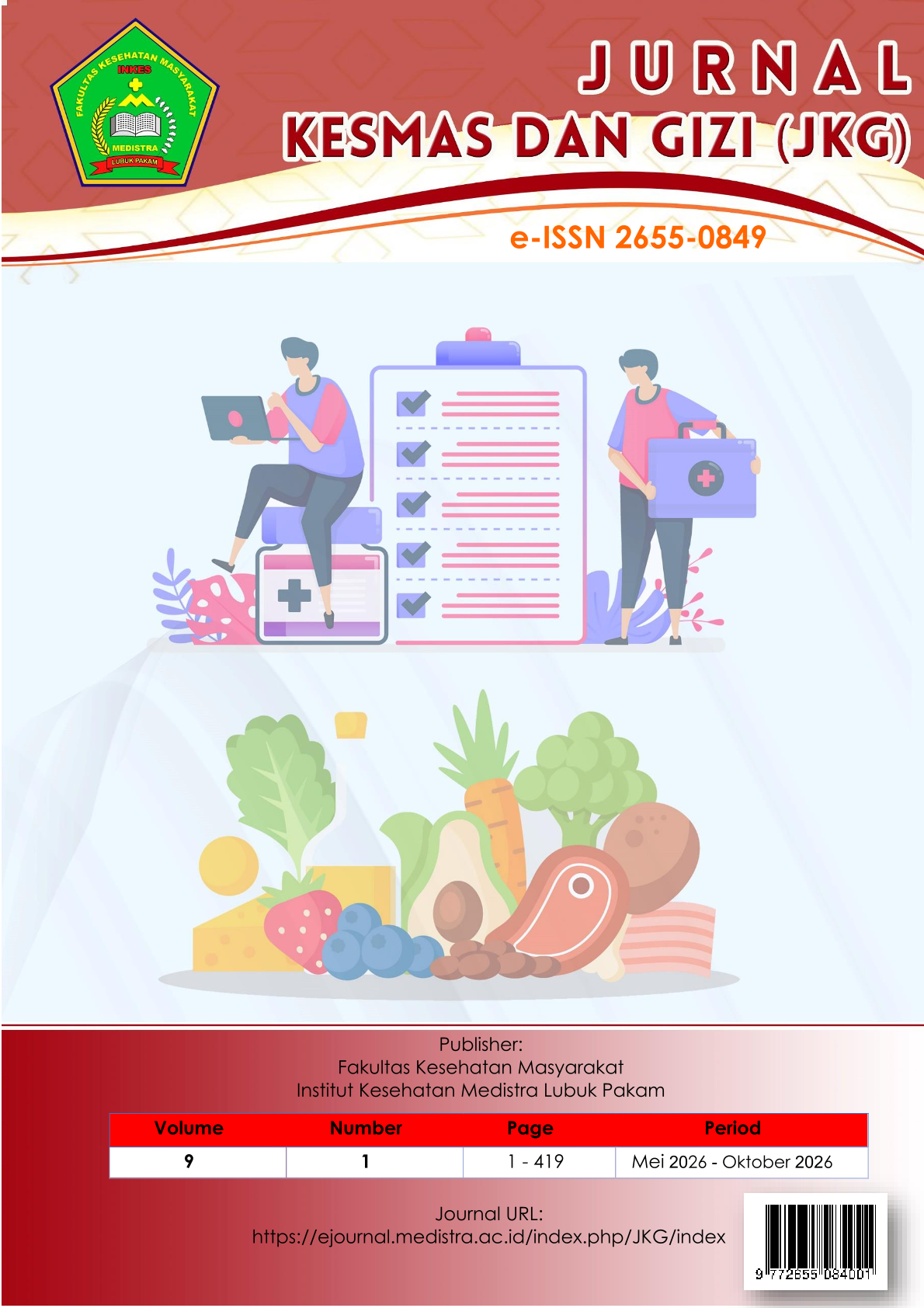
Analysis of pregnant women's behavior in preventing preeclampsia based on the health belief model theory
DOI:
https://doi.org/10.35451/jkg.v9i1.3634Keywords:
Preeclampsi; behavior;, knowledge, attitude, practice, Health Belief ModelAbstract
Preeclampsia is one of the pregnancy complications that remains a leading cause of maternal mortality worldwide, including in Indonesia. The high incidence of preeclampsia indicates that promotive and preventive efforts are still not optimal, particularly those related to maternal health behavior. This study aimed to analyze the behavior of pregnant women in preventing preeclampsia based on the Health Belief Model approach at Setio Husodo Kisaran Hospital. This study employed a quantitative approach with a cross-sectional design. The population consisted of all pregnant women who attended antenatal care, totaling 735 individuals, with a sample of 88 respondents determined using the Slovin formula and consecutive sampling technique. Data were analyzed using univariate, bivariate (Chi-Square), and multivariate (logistic regression) analyses. The results showed that the majority of respondents had poor knowledge (53.4%) and attitudes (54.5%), although most had good practices (53.5%); however, overall preeclampsia prevention behavior was still low (58.0%). Bivariate analysis revealed significant relationships between knowledge (p=0.000), attitude (p=0.000), and practice (p=0.005) with preeclampsia prevention. Multivariate analysis indicated that all three variables simultaneously influenced preeclampsia prevention, with knowledge as the most dominant factor (OR=6.5), followed by attitude (OR=4.1) and practice (OR=3.8). In conclusion, knowledge, attitude, and practice play important roles in preeclampsia prevention, with knowledge being the most dominant factor. Therefore, comprehensive and sustainable educational interventions are needed to improve preventive behaviors among pregnant women.
Downloads
References
[1] K. K. R. Indonesia, “Pedoman pelayanan antenatal terpadu,” 2023.
[2] W. H. Organization, “WHO Recommendations on Antenatal Care for a Positive Pregnancy,” vol. 10, no. January, pp. 1–10, 2023, doi: 10.1186/1742-4755-10-19.5.
[3] K. K. R. Indonesia., Profil kesehatan Indonesia 2022. 2022.
[4] D. K. P. S. Utara., “Laporan Kesehatan Provinsi Sumatera Utara. Medan: Dinkes Sumut.,” 2023.
[5] K. K. R. Indonesia., “Pedoman pelayanan antenatal terpadu,” 2020.
[6] U. Igbokwe et al., “Knowledge , attitude and practice of pre ‑ eclampsia / eclampsia preventive measures among pregnant women in selected primary health care facilities in Kano state : A cross ‑ sectional study,” 2025, doi: 10.4103/jfmpc.jfmpc.
[7] A. L. Frost, K. Suriano, C. Y. L. Aye, P. Leeson, and A. J. Lewandowski, “The Immediate and Long-Term Impact of Preeclampsia on Offspring Vascular and Cardiac Physiology in the Preterm Infant,” vol. 9, no. May, pp. 1–6, 2021, doi: 10.3389/fped.2021.625726.
[8] Q. Yang, K. Han, J. Wang, and Y. Zou, “Literature Overview of Association Between Preeclampsia and Cardiovascular Risk,” vol. 27, no. 4, pp. 179–184, 2023, doi: 10.14744/AnatolJCardiol.2023.2865.
[9] A. Tassi, A. Sala, I. Mazzera, S. Restaino, G. Vizzielli, and L. Driul, “Long-term outcomes of patients with preeclampsia , a review of the literature,” Hypertens. Pregnancy, vol. 42, no. 1, pp. 1–7, 2023, doi: 10.1080/10641955.2023.2217448.
[10] C. L. Jones, J. D. Jensen, C. L. Scherr, N. R. Brown, K. Christy, and J. Weaver, “The Health Belief Model as an Explanatory Framework in Communication Research: Exploring Parallel, Serial, and Moderated Mediation,” vol. 30, no. 6, pp. 566–576, 2020, doi: 10.1080/10410236.2013.873363.The.
[11] S. N. Alkhoiriyah, E. Safariyah, and H. Hadiyanto, “Pengaruh Edukasi Kesehatan Berbasis Pendekatan Health Belief Model ( HBM ) terhadap Peningkatan Motivasi Minum Obat pada Pasien TB Paru di Kelurahan Sindangsari,” vol. 6, 2026.
[12] K. P. Muna et al., “Health Belief Model (HBM) dalam Perilaku Berisiko Praktik Hygiene Makanan dikalangan Mahasiswa Universitas Karya Persada Muna,” vol. 8, no. 6, pp. 1633–1642, 2025.
[13] J. K. Sains et al., “TINJAUAN PERAN HEALTH BELIEF MODEL TERHADAP PERILAKU DIET SEHAT PADA DEWASA AWAL DI KOTA PADANG,” vol. 8, no. 6, pp. 3325–3346, 2025, doi: 10.56338/jks.v8i6.7759.
[14] U. N. C. Fund, “HEALTH RESULTS 2021 MATERNAL , NEWBORN AND,” 2021.
[15] Ms. Ioannis Tsakiridis, PhD, Sonia Giouleka, Alexandra Arvanitaki, P. George Giannakoulas, Georgios Papazisis, k Apostolos Mamopoulos, and and T. D. Apostolos Athanasiadis, PhD, “Gestational Hypertension and Preeclampsia: An Overview of National and International Guidelines,” vol. 76, no. 10, pp. 613–633, 2021.
[16] L. C. P. L. Nguyen- et al., “Hypertensive disorders of pregnancy and long- term cardiovascular health : FIGO Best Practice Advice term Health and the FIGO,” vol. 160, pp. 22–34, 2023, doi: 10.1002/ijgo.14540.
[17] K. Glanz, B. K. Rimer, and K. Viswanath, “Health Behavioral. Theory, Research and Practice,” 2021.
[18] A. Nurdiana, L., Sari, Y. R., & Nuraini, Health belief model Analysis on Hypertension in Pregnancy Prevention. Jurnal Kesehatan Reproduksi.
[19] R. Kartikasari, S. Rohani, and S. Irianti, “Hubungan antara Risiko 4 Terlalu dan Kepatuhan Antenatal Care ( ANC ) dengan Komplikasi Persalinan Correlation between 4 Too Much Risks and Antenatal ( ANC ) Compliance with,” vol. 12, no. 1, pp. 20–28, 2025.
[20] J. T. Atmojo, A. Widiyanto, R. T. Handayani, and A. N. Ningrum, “PROMOSI KESEHATAN,” 2024.
[21] C. Efriana, R. Dewi, K. Nuha, D. Salsabila, S. Arafah, and R. Wika, “DENGAN PENGGUNAAN METODE KONTRASEPSI JANGKA PANJANG ( MKJP ) DI WILAYAH KERJA PUSKESMAS BAITURRAHMAN KOTA BANDA,” vol. 6, pp. 480–489, 2025.
[22] L. R. Anik Sulistiyanti, Febiola Dwi Hastuti, “Tingkat Pengetahuan dan Sikap Ibu Hamil Tentang Preeklamsia Pada Masa Pandemi Covid-19,” pp. 127–133, 2020.
Downloads
Published
Issue
Section
License
Copyright (c) 2026 Irnain Syahdani, Reni Aprinawaty Sirait, Felix Kasim, Achmad Rifai

This work is licensed under a Creative Commons Attribution 4.0 International License.
Copyright in each article is the property of the Author.